


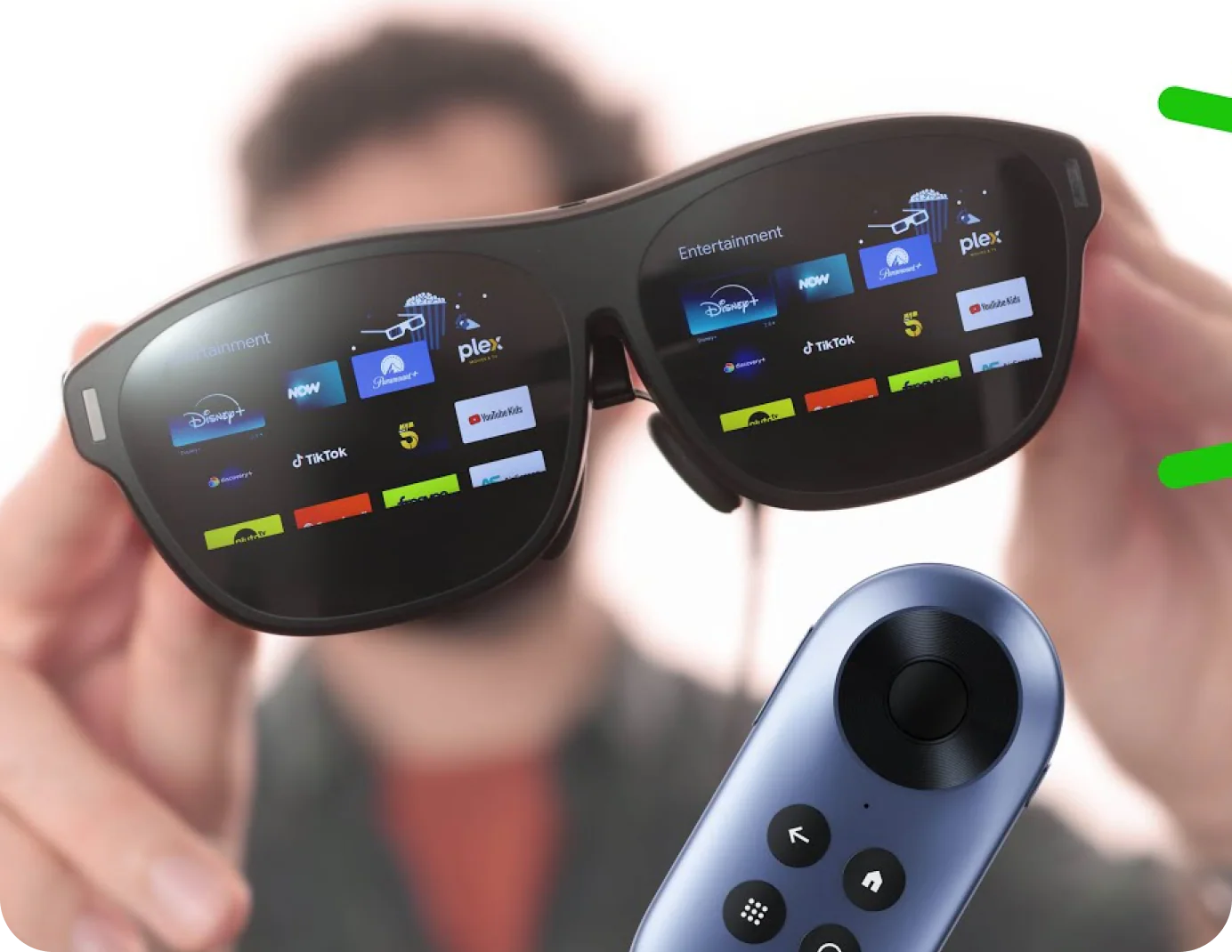
Rokid has been a steady presence in the AR glasses space since 2014, and their latest release represents a solid, iterative improvement rather than a revolutionary leap. And that’s perfectly fine — sometimes the market needs refinement more than reinvention. The new Rokid Glasses deliver exactly what you’d expect from a company that’s been refining AR wearables for over a decade: a lightweight, full-function pair of AI-powered AR glasses that get the fundamentals right.
Announced via a Kickstarter campaign that blew past its $20,000 goal in no time, the Rokid Glasses represent the company’s most ambitious consumer play yet. We went hands-on with them and came away impressed — with a few caveats worth noting.
Design and Build: Lightweight and Premium
At just 49 grams with a magnesium-alloy frame, the Rokid Glasses are among the lightest full-function AR glasses available. The build quality feels premium, and the IPX4 splash resistance provides basic weather protection. They’re available for pre-order through Kickstarter at $499 (a $100 discount off the $599 MSRP), making them a competitive option in a market where feature-rich smart glasses often command a premium.
The right arm houses a touchpad and physical button for navigation, and the glasses support voice commands via the “Hi, Rokid” wake word. Rokid also confirmed prescription lens support through magnetic attachments — a critical feature for everyday wearers — with approximately three weeks lead time for custom lenses.
The Display: Dual Micro-LED
Unlike AI-only glasses like the Ray-Ban Meta or HTC VIVE Eagle, the Rokid Glasses feature actual displays — one in each eye. The dual monochrome green micro-LED displays offer a 480 × 398 pixel resolution per eye with 1,500 nits brightness, delivering a 23° field of view. They’re bright enough for indoor use and should hold up reasonably well outdoors, though the green monochrome display is best suited for text overlays and simple UI elements rather than rich media.
The display approach puts the Rokid Glasses in direct competition with products like the Halliday DigiWindow glasses and Brilliant Labs’ Halo — but with the advantage of binocular displays (one per eye) rather than a single projector.
Real-Time Translation: A Travel Essential
Rokid’s translation capabilities are among the most practical features on the glasses. The system can handle both conversational translation (listening and playing translated audio through the dual HD directional speakers while showing text on the displays) and image-based translation (point your camera at a menu or sign). In our testing, it handled menu translation well — including pricing — though results were somewhat inconsistent on repeat attempts.
The directional speakers and four-mic array with AI noise cancellation ensure clear audio pickup even in moderately noisy environments. For frequent travelers, this alone could justify the purchase.
Teleprompter Mode: A Creator’s Dream
This is where the Rokid Glasses truly distinguish themselves. The built-in teleprompter mode allows content creators to read scrolling script text directly on the display while looking at the camera. It’s a game-changer for long-form video creators who currently lug around physical teleprompters or rely on phone-based solutions that are obvious to the audience.
Paired with the 12MP camera (3:4 aspect ratio photos, 1680p video), the Rokid Glasses become a legitimate content creation tool — unlike the Ray-Ban Meta which excels at casual capture but lacks a display for script reading.
Object and Scene Recognition
The Rokid Glasses include AI-powered object and scene recognition that can identify everything from a wide office space to specific details like a particular brand of flowers. The descriptions are rich and contextual, making this feature genuinely useful for accessibility purposes or quick information lookup. Simply say “Hi Rokid, what’s in front of me?” and the glasses provide a detailed description.
HUD Navigation and Other Features
Turn-by-turn HUD navigation is projected directly into the 23° field of view, keeping directions visible without requiring a phone mount or heads-up glance. The glasses are powered by the Qualcomm AR1 processor with 2GB of RAM and 32GB of onboard storage — roughly in line with competitors like the HTC VIVE Eagle.
The 210mAh battery is modest, but the included charging case provides up to ten full recharges on the go, making all-day use feasible. A sleep mode activated via a touchpad-and-button combo helps conserve power between uses.
AI Platform and App Integration
The Rokid Glasses rely on a combination of AI assistants, notably including ChatGPT for contextual queries and task automation. Every interaction is logged in the companion app, allowing you to review queries and responses on a larger screen later — useful for recalling information you looked up during the day.
The AI platform flexibility mirrors what HTC is doing with the VIVE Eagle’s multi-AI approach, though Rokid’s integration with ChatGPT appears tighter out of the box.
Pricing and Availability
The Rokid Glasses are available on Kickstarter at $499 (MSRP $599). The campaign includes the glasses, charging case, and magnetic prescription lens attachments. The announced timeline suggests deliveries to backers before wider retail availability.
How It Stacks Up
The Rokid Glasses occupy an interesting middle ground in the smart eyewear landscape:
- vs. Ray-Ban Meta ($299+): The Meta excels at audio and casual content capture but lacks a display. Rokid gives you actual AR overlays, translation, and a teleprompter — but weighs more and costs more.
- vs. Halliday ($499): Both have displays, but Rokid offers binocular micro-LED (one per eye) vs. Halliday’s single DigiWindow projector. Rokid also adds a camera, which Halliday lacks entirely.
- vs. HTC VIVE Eagle ($520): Both have cameras and AI, but Rokid adds binocular AR displays. HTC’s multi-AI platform flexibility is its edge.
- vs. Even Realities G1 ($600+): G1 is more polished but more expensive with a narrower feature set.
The Verdict
The Rokid Glasses represent a solid, well-rounded entry in the AR smart glasses category. They don’t try to reinvent the wheel — instead, they deliver a thoughtful combination of features that actually solve real problems: translation, teleprompter, navigation, and object recognition, all wrapped in a comfortable 49-gram frame with actual binocular displays.
The inconsistency in translation results and the relatively modest battery (mitigated by the charging case) are worth noting, but as a first-generation product from a company with deep AR experience, the Rokid Glasses are a genuinely impressive effort. If you’re a creator, frequent traveler, or early AR adopter, these are worth a serious look.
Rokid has been building AR hardware since 2014, and it shows. This isn’t a startup throwing spaghetti at the wall — it’s a seasoned player delivering a focused, capable product. And that’s a solid effort by any measure.
