


Share This Article
Halliday made one of the biggest splashes at CES 2025 with a bold promise: proactive AI glasses that look ordinary, feel lightweight, and project information directly into your field of view through an invisible display. After a massively successful Kickstarter campaign that raised over $3.3 million from more than 8,000 backers, the glasses are finally here.
But does the reality live up to the ambition? Let’s dig into what Halliday has delivered — the innovations, the rough edges, and where it fits in the rapidly expanding smart eyewear landscape.
What Is Halliday?
Halliday is a smart eyewear startup founded by a team with experience in traditional eyewear manufacturing. That heritage shows — the glasses are clearly designed by people who understand how glasses should fit and feel. The company’s flagship product is a pair of Wayfarer-style smart glasses weighing just 28.5 grams (about 40 grams with prescription lenses), making them among the lightest smart glasses on the market.
The headline feature is Halliday’s proprietary DigiWindow technology: a 3.6mm microLED projector mounted on a small cantilever arm above the right lens. Instead of using waveguide prisms embedded in the lens (which add weight and cost), DigiWindow projects a green monochrome display directly into your peripheral vision. Halliday claims this is the equivalent of a 3.5-inch screen visible only to the wearer.
Design and Comfort
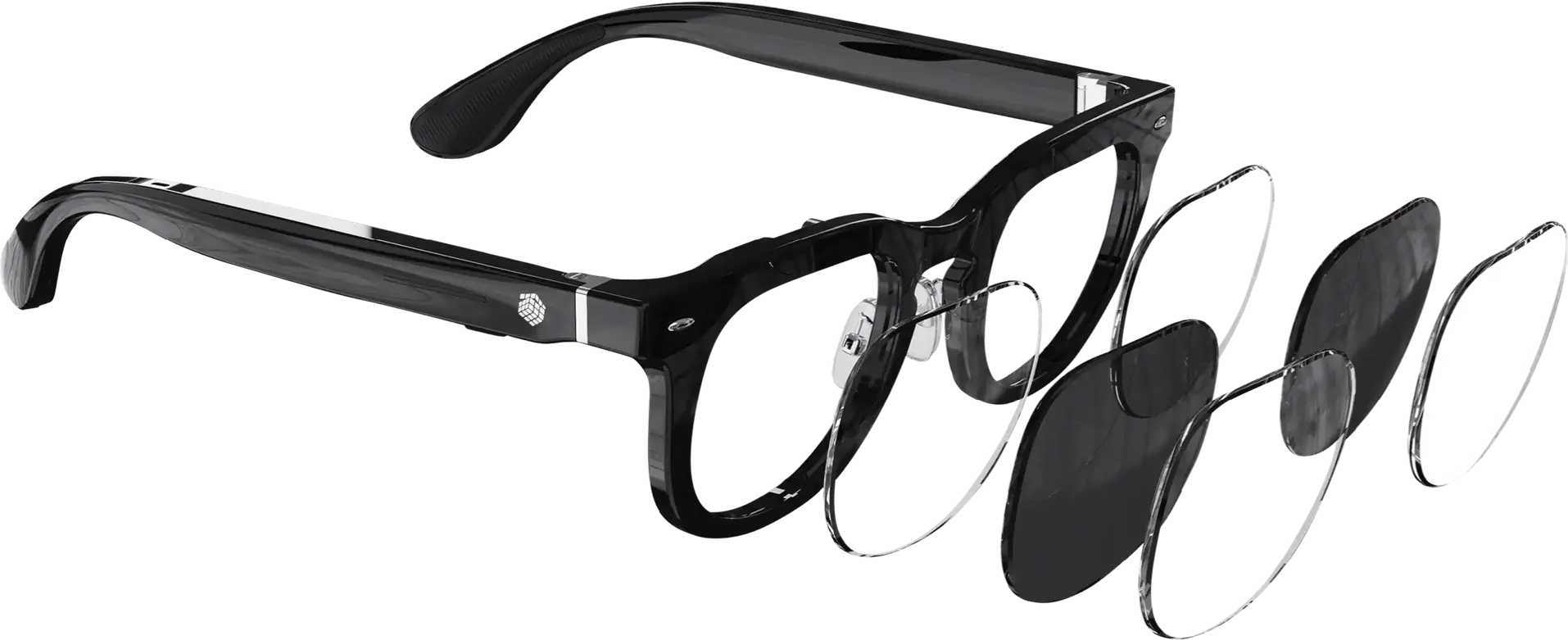
This is where Halliday genuinely shines. The glasses are available in Black, Gradient (fading from black to clear), and Tortoiseshell. The classic Wayfarer shape is universally flattering, and the lightweight construction means you can wear them all day without discomfort. Metal supports with silicone nose pads provide a secure fit, and the arms are slim enough to avoid that “bulky tech gadget” look.
The right temple features a touch-sensitive trackpad for controls, a physical action button underneath, dual speakers (one in each arm), and a USB-C charging port hidden behind a rubber gasket. IP54 dust and water resistance adds peace of mind for everyday wear.
One of Halliday’s strongest selling points is prescription compatibility. Unlike waveguide-based smart glasses that require specialized lenses, Halliday uses standard prescription lenses — making them far more accessible for the millions of people who already wear glasses daily.
The DigiWindow Display
The display module slides in and out on a rail and tilts up and down, allowing you to find the sweet spot for your eye. A diopter adjustment (-800 to +200) means it works even for people with significant vision correction needs. The green monochrome interface shows the time, date, battery level, notifications, and AI responses.
In practice, the display is sharp for text but requires deliberate effort to use. You have to look up and inward to see it — and anyone you’re talking to will notice you doing it. Reading more than a few lines, especially during conversations, can become uncomfortable. It’s best suited for quick glanceable information: incoming messages, reminders, and short AI snippets.
Proactive AI: The Marque Feature
Halliday’s flagship feature is its Proactive AI, which listens to your conversations and provides contextual information, suggested follow-up questions, fact-checking prompts, and summaries — all displayed on the DigiWindow screen in real time. Think of it as a subtle conversation co-pilot.
In theory, this is a fascinating concept. You’re in a meeting discussing a topic you’re not fully up to speed on, and Halliday quietly fills in the gaps. A friend mentions a band you don’t know, and Halliday gives you a one-liner. In practice, the feature is still rough around the edges. The AI tends to treat every sentence as a prompt, including filler words and hesitations. The responses can lag enough that by the time you read them, the conversation has moved on. And staring upward to read multi-line text during a conversation is anything but subtle.
That said, the underlying concept is genuinely novel, and with software improvements, it could evolve into something compelling. Halliday also offers Reactive AI (ask questions directly, like “Hey Google” for your glasses), live translation, and a Cheatsheet feature that acts like a personal teleprompter for presentations or speeches.
The Smart Ring Controller
Halliday includes a dedicated smart ring for hands-free control of the glasses. It features a small clickpad that supports taps, swipes, and clicks. The idea is you can navigate menus and trigger actions without raising your hand to your face.
It’s an ambitious concept, but execution is mixed. The ring tends to rotate on your finger unless worn very tightly, making it easy to lose track of which direction the controls face. The touchpad is small, and input lag means you might overshoot your intended selection. Many users end up defaulting to the glasses’ built-in touchpad instead. The ring charges via a small magnetic USB dongle — another thing to keep track of and charge.
Speakers, Battery, and Charging
The built-in speakers are functional for notifications and calls but lack bass and sound tinny for music — a common trade-off for open-ear audio in this form factor. Battery life is rated at 12 hours of “all-day use,” but real-world performance depends heavily on how much you engage the display and AI features. Heavy use (translation, streaming, frequent AI interactions) will drain the battery significantly faster.
Charging is via USB-C on the temple arm, behind a rubber gasket that can be finicky to open. The smart ring charges separately via a small magnetic dongle.
Pricing and Availability
The Halliday Glasses retail for $499, with prescription lenses included at no extra cost. The smart ring is currently bundled for free but will eventually cost $69. The glasses are available through Halliday’s website in three color options.
Advanced AI features (Proactive AI, premium translation, Audio Memo) operate on a credit system. Each pair comes with 9,200 free credits valid for one year (plus 480 monthly credits), after which additional credits cost roughly $10 per 1,000 — equating to about five hours of Proactive AI use.
How It Stacks Up
Halliday enters a competitive market with distinct positioning. Compared to:
- Ray-Ban Meta ($299+): The reigning champion for many. Has a camera, far better speakers, longer battery life, and Meta’s ecosystem. No built-in display. If you want a camera and great audio, this is still the pick.
- Even Realities G1 ($600 + lenses): More polished but pricier. Uses a different display technology that some find easier to use. More limited feature set, but things that work tend to work well.
- Brilliant Labs Halo ($299): Similar microLED approach at a lower price point. More developer-focused, less consumer polish.
- Rokid Glasses ($549 Kickstarter / ~$750 retail): Waveguide display with camera and AI. Still in crowdfunding phase.
Halliday’s differentiator is its combination of extreme light weight, prescription compatibility, and that Proactive AI. No other smart glasses attempt to be an always-on conversation companion in quite the same way.
The Verdict
The Halliday Glasses are one of the most ambitious smart eyewear products to hit the market. The hardware foundation — lightweight, comfortable, prescription-ready, with a genuinely private display — is solid. The company clearly prioritized making glasses that people would actually want to wear, and in that regard, they’ve largely succeeded.
Where Halliday stumbles is in the software experience and some execution details. The Proactive AI is a genuinely new idea, but it’s not ready for prime time in its current form. The smart ring adds complexity without enough benefit. The display is clever technology but physically awkward to engage with during conversations. And the speakers are underwhelming.
Halliday is a promising first-generation product from a company that clearly has good instincts about hardware design. With ongoing software updates, many of its rougher edges could be smoothed out. For early adopters and smart eyewear enthusiasts who want to be at the cutting edge, the Halliday Glasses offer a genuinely unique experience you can’t get anywhere else right now.
For most people today, the Ray-Ban Meta or Even Realities G1 are more polished choices. But keep an eye on Halliday — if they iterate on the software as well as they’ve built the hardware, this could be a name we’re talking about for years to come.
What do you think — is proactive AI the future of smart eyewear, or are we better off with simpler, more focused devices? Let us know in the comments.
