


Share This Article
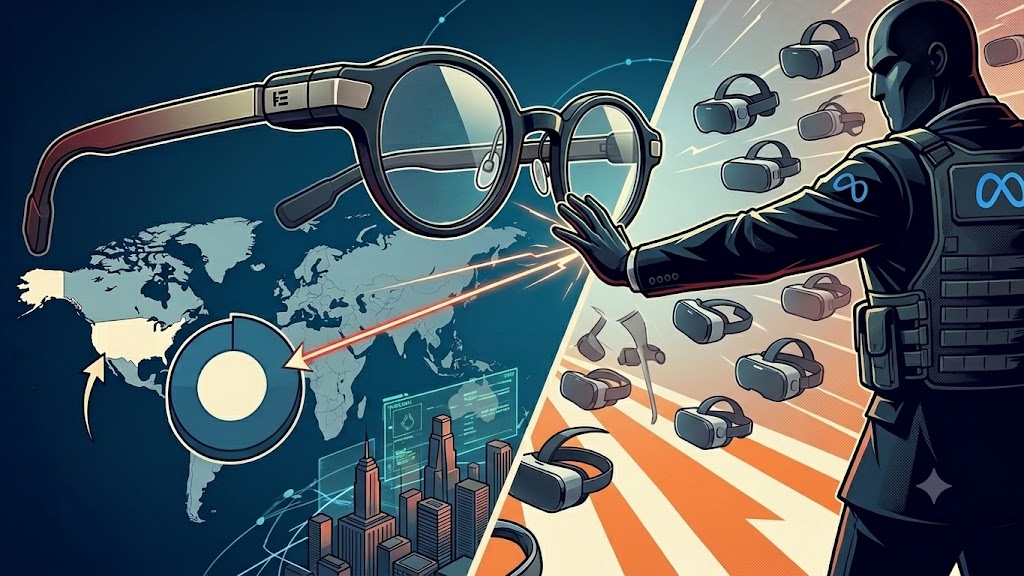
Even Realities has hit a billion-dollar valuation, but the real story is where its customers actually live. More than half of the Shenzhen-based company’s user base is in the United States, and roughly 80 percent of its developer community is American too. That makes Even a rare breed: a Chinese-funded hardware startup building its biggest beachhead in Meta’s strongest market.
The company’s G2 glasses skip the camera entirely and lean on a heads-up display instead. Navigation prompts, translation overlays, notifications, and AI-powered information appear directly in the wearer’s line of sight. It is a deliberate counterpoint to the camera-first approach Meta has taken with its Ray-Ban partnership. Where Meta bets that users want to capture and share, Even Realities bets they want to glance and know.
That product bet is working in unexpected places. While Meta dominates the global smart glasses category with an estimated 70 percent market share in Q1 2026 according to IDC, Even is carving out a different lane. Its main markets include the US, Japan, South Korea, the Middle East, and Europe. The company is effectively using Chinese manufacturing capital and supply chains to compete in regions where Meta already has deep distribution and brand recognition.
The pricing reflects the premium positioning. The G2 starts at $599, and adding prescription lenses or the R1 ring controller can push the real cost closer to $1,000. That is a steep ask compared to Meta’s $299 glasses, but Even is selling a different value proposition: privacy through no-camera design and utility through an always-visible display.
Even is not the only Chinese player circling the space. Alibaba has shown its Quark AI glasses, Rokid is valued at roughly $2.58 billion, and RayNeo backed by TCL is active in AR eyewear. The category is heating up because smart glasses are becoming one of the most believable AI hardware form factors. Information appears without pulling out a phone, and the form factor is socially acceptable in ways that headsets never were.
The question now is whether Even can scale its US user base fast enough. Meta, Samsung, Google, and Snap are all moving into the same space. Even has early traction, Chinese backing, and a differentiated product. The next twelve months will determine whether that is enough.
Source: Mixed News
