


Share This Article
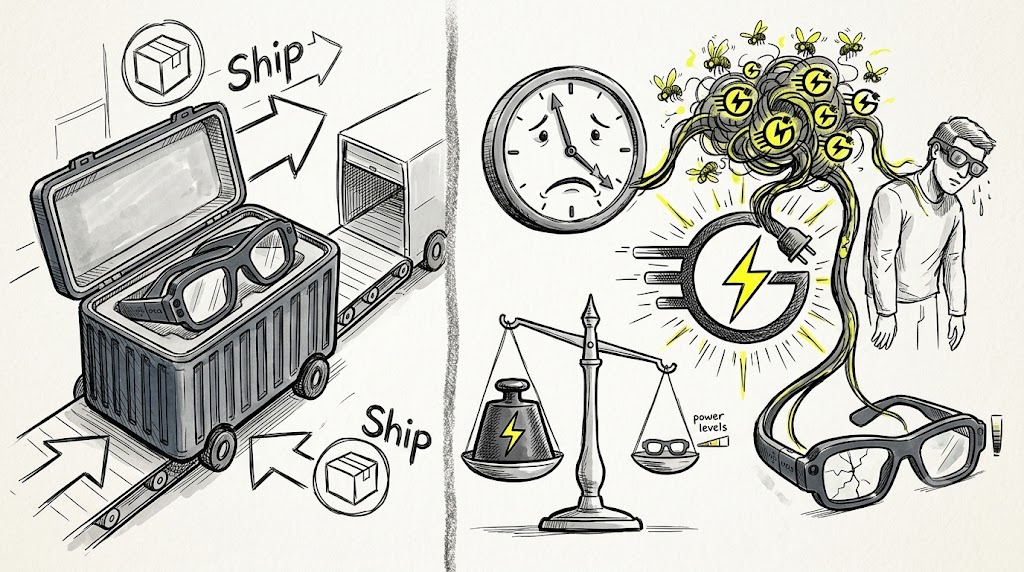
A charging case that holds four extra refills sounds familiar — phone users have leaned on that crutch for years. When Snap confirmed its $2,195 Specs would ship with exactly that accessory, it quietly told early adopters something the keynote glossed over: the glasses themselves only last about four hours on a charge.
That number changes the conversation around Snap’s ambitious AR debut. Four hours is enough for a long dinner, a museum visit, or a commute punctuated by short AR sessions. It is not enough for a full workday, a cross-country flight, or the kind of always-on computing that the company is pitching as a phone replacement. The charging case bridges the gap, but it also introduces friction — now users carry two items instead of one, and they still need to dock the glasses mid-day to get a full shift out of them.
Snap is betting that the use cases for Specs will cluster around short, intentional experiences rather than all-day wear. Early developer demos at AWE leaned into that assumption: golf swing analysis, guided museum tours, quick navigation overlays, and shared AR photo sessions. None of these demand eight hours of uptime. The question is whether that use pattern justifies a $2,195 entry fee when a pair of $299 Meta Ray-Ban smart glasses can handle voice AI and notifications all day without breaking a sweat.
The hardware inside Specs explains some of the battery math. Dual Qualcomm processors, a high-resolution waveguide display, and multiple cameras draw power at a rate that smaller smart glasses can’t match. Snap’s custom OS also needs to keep the spatial mapping and hand-tracking pipelines running continuously. Those engineering choices deliver a richer AR experience than any glasses at this price point, but they come with a tether to the charging case that simpler devices avoid.
Early hands-on reports from AWE described the optics as impressive and the form factor as genuinely wearable — lighter and less obtrusive than any VR headset by a wide margin. But those same reports noted that demo units were frequently rotated back to charging stations. Reviewers praised what Specs could do in short bursts while flagging that extended sessions push the hardware into thermal and battery limits that phone-style cases can only partially solve.
For developers building on Snap’s Lens Studio, the battery constraint becomes a design constraint. Apps need to deliver value in focused sessions rather than passive background use. That aligns with Snap’s stated philosophy — its own CEO described Specs as augmentation rather than replacement — but it also means the app ecosystem will evolve differently than smartphone apps did. AR sessions for Specs will be deliberate, not ambient.
Fall 2026 shipping means Snap has a few more months to tweak power management before units land in customer hands. Whether four hours plus a case full of top-ups is enough will ultimately depend on what people actually do with the device. But the accessory itself is telling: Snap knows its hardware isn’t ready for all-day independence, and it’s asking buyers to accept the trade-off rather than wait for a future revision.
Source: Glass Almanac
